



Prep Time30 minutes
Total Time3 hours 55 minutes
Servings12 Servings

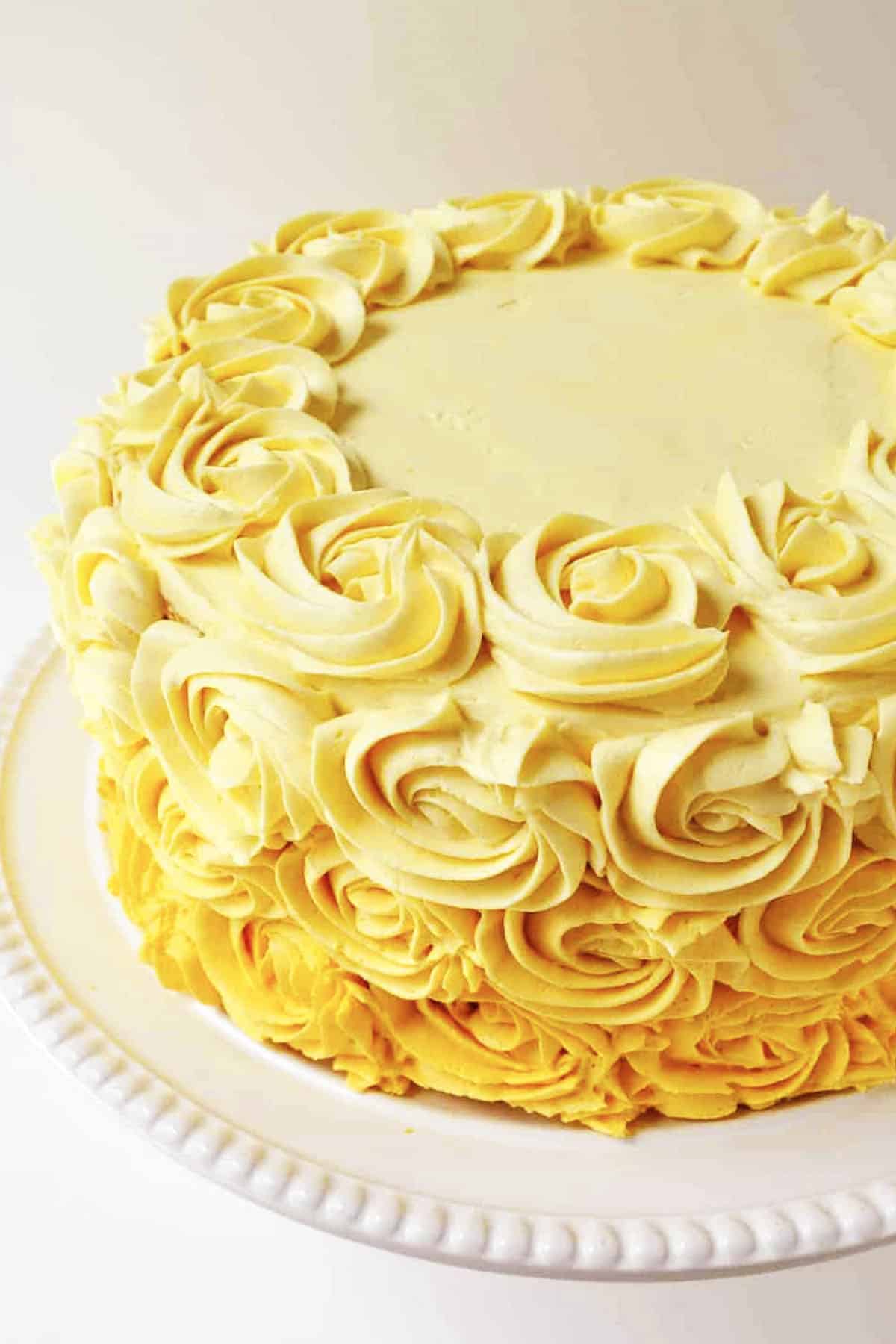
This yellow ombre cake is the kind of showstopper that makes people think you spent three days in a professional bakery…when really, you just followed a really good recipe. Three layers of tender vanilla cake, each tinted a slightly deeper shade of golden yellow, stacked tall and frosted with the fluffiest buttercream rosettes in three graduating hues. It is equal parts dramatic and delicious, and yes, you can absolutely pull it off at home.

If you love a cake that looks like it belongs on a dessert table but tastes like something grandma would have made, you are in exactly the right place. This one pairs beautifully with a scoop of no-churn ice cream or alongside a slice of something from my dessert archives.
In This Post
Why This Works
The secret to a truly stunning ombre effect is not some professional trick, it is just a little bit of patience and a toothpick. By using the same batter and the same frosting, then tinting each portion with slightly different amounts of gel food coloring, you get a cohesive, naturally graduated look that photographs like a dream. No separate recipes, no complicated techniques.
The cake itself leans on a combination of cake flour, egg whites, and shortening alongside butter, which gives it that ultra-fine, bakery-style crumb that holds up beautifully under the weight of all that glorious buttercream. It is sturdy enough to stack, delicate enough to melt in your mouth.
Heather’s Recipe Notes
- Gel food coloring is non-negotiable here. Liquid coloring will throw off your batter consistency and give you muddy, uneven color. Wilton Buttercup Yellow is the exact shade used in this recipe.
- Weigh your batter. Dividing into three equal pans by eye is a recipe for uneven layers. A kitchen scale takes the guesswork out entirely, aim for about 593 grams per pan.
- The frosting needs to be whipped long enough to get truly fluffy. Eight minutes on the butter alone before adding anything else is not a suggestion, it is the move.
- When piping the rosettes, start from the center of the top and work outward in concentric circles before moving to the sides. This keeps the pattern consistent and makes the whole thing look intentional.
- Let the iced cake chill in the fridge for 20 to 30 minutes before serving, then pull it out and let it come to room temperature for about 20 minutes. Cold buttercream loses its silky texture, and this cake deserves to be at its best.
The Maillard Reaction
You might not think of cake as a Maillard situation, but that golden color on the edges and bottom of each layer? That is not just aesthetics. The Maillard reaction is a chemical process that happens when amino acids and sugars hit heat above around 280 degrees F, creating hundreds of new flavor compounds in the process. In a vanilla cake, it is responsible for the slightly toasty, caramelized notes that keep the flavor from being one-dimensional.
This is also why baking at 350 degrees F matters. Too low and the cake steams rather than bakes, turning out pale and flat. Too high and the outside browns before the inside has a chance to set. That sweet spot lets the Maillard reaction do its thing on the surface while the interior stays moist and tender all the way through.
Ingredients to Make Vanilla Cake
For the Vanilla Cake:
- Flour: 2 ½ cups of all-purpose flour for structure.
- Sugar: 2 cups of granulated sugar for sweetness.
- Butter: 1 cup (2 sticks) of unsalted butter, softened.
- Eggs: 4 large eggs for richness and moisture.
- Milk: 1 cup of whole milk to keep the cake tender.
- Baking powder: 2 ½ teaspoons to help the cake rise.
- Vanilla extract: 1 tablespoon of pure vanilla extract for that classic flavor.
- Salt: ½ teaspoon to balance the sweetness.
For the Buttercream Icing:
- Butter: 1 cup (2 sticks) of unsalted butter, softened.
- Powdered sugar: 4 cups, sifted, for sweetness and structure.
- Heavy cream: 2-3 tablespoons to achieve the perfect consistency.
- Vanilla extract: 1 teaspoon for flavor.
- Salt: A pinch to balance the sweetness.
Subs & Variations
- No cake flour? Use all-purpose flour and swap out 2 tablespoons per cup with cornstarch, then sift twice. It gets you close to that same fine crumb.
- Shortening can be replaced with an equal amount of additional butter if you prefer to avoid it, though the crumb will be slightly denser.
- Want a different color palette entirely? This same technique works with any gel color — blush pink for a Valentine’s cake, lavender for a spring baby shower, even deep burgundy for the holidays.
- For a lemon ombre variation, swap the almond extract for lemon extract and add a tablespoon of lemon zest to the batter. Pair it with a lemon buttercream for a bright, citrusy version.
- The rosette piping can be swapped for simple swirls, smooth frosted sides with a palette knife, or even a naked cake finish if you want something more relaxed.

Tips for Storing
- Store the finished cake covered at room temperature for up to two days. The buttercream acts as a seal and keeps the layers from drying out.
- For longer storage, refrigerate the cake loosely covered with plastic wrap for up to five days. Bring it fully to room temperature before serving.
- Unfrosted cake layers can be wrapped tightly in plastic wrap and frozen for up to three months. Thaw overnight in the fridge before assembling.
- Leftover slices freeze well individually wrapped. They thaw on the counter in about an hour, which is honestly a great Tuesday afternoon problem to have.
- Already-frosted cake can also be frozen whole. Freeze it uncovered first until the frosting is firm, then wrap it in plastic and foil. Thaw in the fridge overnight.
People Also Ask
Yes, and it actually benefits from it. Bake the layers a day ahead, wrap them well, and refrigerate overnight. Make the frosting fresh the day of assembly for the best texture.
This usually happens when the colors are too close together in shade, or when the gel coloring is not fully mixed into the frosting. Make sure each batch is thoroughly blended before piping, and space the shades further apart than you think you need to.
You can, though the crumb will be slightly different and it will not hold the three-layer structure quite as elegantly. If you go that route, use two boxes and follow the ombre tinting method exactly as written.
A 1M star tip is what creates that large, open rosette look. It is the most forgiving piping tip for beginners and gives you a professional result without requiring much practice.
Absolutely. Use two 9-inch pans, divide the batter in half, and tint one slightly darker than the other. The ombre effect will be more subtle but still beautiful.
Weighing the batter on a kitchen scale before pouring into the pans is the most reliable method. A cake leveler or long serrated knife can also even out any doming after baking, before you stack.
More Cake Recipes
- Best Carrot Cake Recipe
- Strawberry Cupcakes
- Chocolate Port Wine Cake
- Caramelized Apple Spice Cake
- Rhubarb Crunch Cake
- Pineapple Mango Upside Down Cake
Yellow Ombre Vanilla Cake Recipe
Recommended Tools
Ingredients
Vanilla Cake
- 1 cup milk
- ½ cup heavy whipping cream
- 7 large egg whites, room temperature
- 1 large egg, room temperature
- 1 tbsp vanilla extract
- ½ tsp almond extract
- 4 cups cake flour, sifted twice
- 2 ¼ cups granulated sugar
- 1 ¾ tbsp baking powder
- 1 tsp kosher salt
- ¾ cup unsalted butter, room temperature cut into pieces (1.5 sticks)
- 6 tbsp shortening
- Buttercup Yellow Wilton Gel Coloring, optional
Vanilla Frosting
- 2 ½ cups unsalted butter, at room temperature (5 sticks)
- 5 ¼ cups powdered sugar, sifted (powdered sugar)
- 4 ½ tbsp milk
- 1 tbsp vanilla extract
- ¼ tsp kosher salt
- Buttercup Yellow Wilton Gel Coloring, optional

Instructions
Vanilla Cake
- Preheat oven to 350 degrees F. Butter and line three 9″ cake pans with parchment and butter parchment. Set aside.
- In a 2 cup glass measure, add the milk and heavy cream. In a medium bowl combine the egg whites, whole egg, 1/2 cup of milk mixture, vanilla and almond extract. Stir to combine. Set aside.
- In the bowl of an electric mixer fitted with the paddle attachment add all of the dry ingredients (cake flour, sugar, baking powder and salt). Mix on low speed for 30 seconds to combine.
- Add the butter and shortening to the flour mixture and mix on low speed for about 30 seconds. Add the remaining 1 cup of milk/cream mixture and mix on low speed until just moistened. Increase to medium speed and mix for 90 seconds.
- Scrape down the sides and add the egg mixture in 3 additions, beating on medium for 20 seconds after each addition.
- Divide the batter into the 3 equal parts Note: it’s best to weigh the cake batter on a scale for precise layers – 593 grams each). Tint the first batch by adding 1/8 teaspoon Buttercup yellow gel coloring, mix well to combine and add to one of the prepared cake pans. In the second batch add 1/16 teaspoon (you may need to eyeball this if you don’t have that measure), mix well to combine and add to one of the prepared cake pans. For the last batch, dip the tip of a butter knife 1/2 inch into the gel and add to the cake batter, mix well to combine and add to the last cake pan.
- Bake for 22-25 minutes or until a cake tester comes out clean. Remove and cool on a wire rack for 10 minutes in the pan before turning out to cool completely.
Vanilla Frosting
- In the bowl of an electric mixer fitted with the paddle attachment, whip butter for 8 minutes on medium speed.
- Add remaining ingredients and mix on low for 1 minute. Increase speed to medium and whip for 6 minutes.
- Divide frosting into 3 batches with one batch having more than the other 2 (this will be your top layer of frosting and requires more roses). Tint the first smaller batch with 1/8 tsp gel coloring and mix well to combine. Place the darkest cake layer on a cake plate or pedestal. Add 2/3 of the frosting and add a layer to the top of the cake and then do a light skim coat on the sides. Tint the next smaller batch with 1/16 teaspoon gel coloring. Add the next medium colored cake layer to the first and repeat the process of frosting the center and skim coating the sides. For the last batch of icing dip the butter knife 1/2 inch into the gel coloring, add to the icing and mix to combine. Top the cake with the final cake layer. Coat the top with a generous layer of icing and skim coat the sides.
- Use a 1M star tip and disposable piping bag and fill with the darkest icing color. Starting from the center pipe 2 concentric circles. Repeat around the cake. Wash the tip and repeat with the medium yellow icing and so on.
- Refrigerate for 20-30 minutes to set the icing. Remove and let rest at room temperature for 20 minutes before serving.
Save this Recipe!
Easily save this recipe to your own recipe collection box and come back to it anytime you want!
Notes
Nutrition
*Nutritional information is not guaranteed to be accurate.
Did you try this recipe?
Please Leave a Review & Star Rating!
Hi! I’m Heather
I’m Heather, a recipe developer and content creator based in Vancouver, Washington. I started Farmgirl Gourmet in 2006 because I believed weeknight dinners shouldn’t be boring and gourmet shouldn’t mean complicated. I’m also the co-founder of Spiceology, so safe to say I think about food for a living. Stick around for recipes that actually make it into your regular rotation.
so delicious and beautiful
I’ve chosen your “do-over” cake to make for my Mom’s 65th birthday bash. Thank you in advance and I’ll let you know how it goes!
Hope you love it as much as Karen did Renata. Happy birthday to your mom. 🙂