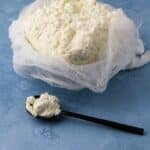
Homemade Ricotta Cheese
Homemade ricotta is so simple to make you'll wonder why you haven't tried it sooner. And the taste...so delicious!
Servings 8 Servings
Ingredients
- 1 tbsp sea salt untreated like Sel Gris or Grey Salt
- 2 cup water
- 1 gallon whole milk
- 16 oz heavy cream
- ⅓ cup lemon juice from 2 lemons or 1/3 cup apple cider vinegar

Instructions
- Mix the sea salt and water, until mostly dissolved.
- In a large stock pot, add the milk, heavy cream and sea salt water.
- Heat over medium-low heat until the milk begins to boil softly. this can take some time, make sure to keep an eye on it or it can scorch.
- Add the lemon juice and stir with a wooden spoon to combine. watch for the curds to come to the surface. once you have a thin layer of curds, remove from the heat and let sit undisturbed for 10 minutes.
- Place a double thickness of cheese cloth (you can buy this at the local fabric store) in a colander set in the sink. with a slotted spoon, skim the curds off the top and place in the colander. what will remain will be a yellowish colored water. you can feed this to your chickens and cats like it as well, or you can toss it out.
- Gather the cheese cloth corners and tie them around a long utensil set over the sink and let drain for 20-30 minutes or until the desired consistency the longer you hang it, the dryer the cheese. Store in the fridge up to 3 days.
Notes
FAQ’s About Homemade Ricotta
Can I use vinegar instead of lemon juice?Yes! Both lemon juice and apple cider vinegar provide the acid needed to separate the curds from the whey. Apple cider vinegar has a milder flavor, while lemon adds a bright, citrusy note. Can I use reduced-fat milk?For the creamiest results, stick to whole milk and heavy cream. Using reduced-fat or skim milk may yield less curd and a drier texture. Is the leftover whey useful?Absolutely. Whey is full of protein and nutrients. Use it in smoothies, soups, or bread dough. It’s also great for feeding chickens or watering acid-loving plants like tomatoes. What if my milk doesn’t curdle?If curds don’t form, your milk may not be acidic enough. Add another tablespoon of lemon juice or vinegar and gently stir. Also, be sure you’re using non-ultra-pasteurized milk for best results.
Nutrition
Calories: 491kcal | Carbohydrates: 25g | Protein: 17g | Fat: 37g | Saturated Fat: 23g | Polyunsaturated Fat: 1g | Monounsaturated Fat: 9g | Cholesterol: 125mg | Sodium: 1071mg | Potassium: 778mg | Fiber: 0.03g | Sugar: 25g | Vitamin A: 1653IU | Vitamin C: 4mg | Calcium: 625mg | Iron: 0.1mg
